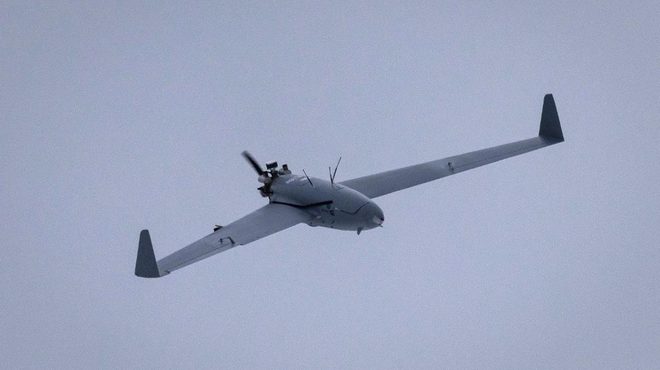
As of August 2026, Russia has stockpiled approximately 6,200 Shahed kamikaze drones of various versions. This was reported by the Main Intelligence Directorate of Ukraine’s Ministry of Defence. The UK Ministry of Defence cited the same figure last month.
Russia is accumulating these drones to carry out massive combined strikes against Ukrainian territory. At the same time, limited production capacity prevents Russian forces from sustaining a high launch tempo continuously.
The largest-scale strikes may involve 600–1,000 drones, while during accumulation periods Russian forces typically launch around 150–200 UAVs per attack, with the maximum reaching approximately 300 drones.
Given that production of Shahed-4 and Shahed-5 variants amounts to approximately 3,000 units per month — not counting the Shahed-2 version — Russia is still unable to sustain high-intensity launches throughout an entire month.
According to the Ministry of Defence, following the introduction of an After Action Review procedure and the scaling up of interceptor drones, the interception rate of Russian drones rose from 83% to 91%. These figures were cited by Mykhailo Fedorov on 16 July when reporting on the Ministry of Defence’s results since he assumed the post.
The supply dynamics are also confirmed by contract data: since the beginning of 2026, under agreements with the Defence Procurement Agency, the armed forces have received twice as many interceptor drones as during all of 2025. In February 2026, interceptors alone destroyed more than 10,000 Russian UAVs.
The Ministry of Defence has declared a strategic goal of reaching a stable 95% aerial target interception rate. To this end, an after-action review procedure has been introduced into the air defence system — a standard NATO practice of debriefing combat operations after each attack.
Ukraine is also scaling up its long-range strike campaign against drone and munitions production infrastructure on Russian territory. According to the National Security and Defence Council, Ukraine’s deep-strike production capabilities as of 2026 are estimated at approximately $25 billion. The goal of such operations is to destroy enemy drones at the assembly stage.
Ukraine does not publish open data on the number of drones launched toward Russia to strike strategic targets. The enemy’s Ministry of Defence regularly publishes its own figures on Ukrainian UAVs shot down, but these cannot be independently verified. For example, in May it was claimed that 9,418 Ukrainian vehicles had been shot down.
Iryna Terekh, CEO and CTO of Fire Point, wrote on Instagram on 12 August:
As of this day in 2026, over 300 long-range drones fly toward the enemy every evening, and since the beginning of the year Ukraine has launched twice as many deep strikes into Russia as Russia has launched against us.