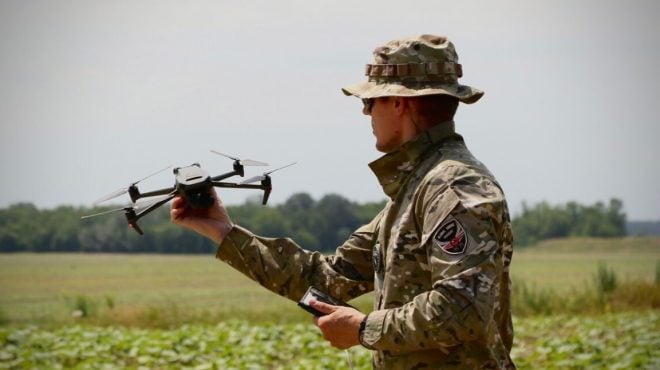
Ukrainian forces conducted the world’s first aerial evacuation of a wounded soldier directly from a position on the front line.
The 92nd Separate Assault Brigade named after Ivan Sirko reported this; the brigade published footage of the operation on October 19.
According to the brigade, a wounded infantryman from the 30th Separate Mechanized Brigade was at a position from which evacuation by conventional UGVs was impossible due to dense mining and high enemy drone activity. As clarified by the Kharkiv hospital, several attempts to evacuate the soldier by various means, including UGVs, were thwarted by the Russians.
The unmanned ground systems company of the 92nd Brigade decided to act by air. It adapted a heavy hexacopter made by Ukrainian manufacturer Gurzuf Defence, which the company provided free of charge. According to the brigade, together with the manufacturer they implemented a technical solution that enabled the drone to carry out the evacuation without tipping over or excessive swaying. Prior to the mission, trials were conducted at the manufacturer’s test sites.
The drone was piloted by a UAV operator from the 30th Separate Mechanized Brigade, a pilot with the call sign “Chornyi” (Black). According to him, the day before the operation he recorded a video instruction for the wounded soldier explaining how to put on the equipment and secure himself on board. During the flight, the servicemen could see the soldier through the drone’s camera. He quickly and clearly secured himself and made a heart gesture with his fingers.
A representative of Gurzuf Defence told the hospital that the drone had to cover more than 15 kilometers with the wounded soldier on board under conditions of constant threat and electronic warfare suppression.
The operation was carried out through the joint efforts of the 92nd Separate Assault Brigade, the 30th and 14th Separate Mechanized Brigades, the 10th Army Corps, and Gurzuf Defence. According to the commander of the 10th Army Corps, Artem Bohomolов, unmanned systems forces, artillery, electronic warfare, and air defense were involved in the planning. A soldier of the 92nd with the call sign “Vader” called it “a big deal” and “Star Wars.”
According to the Kharkiv hospital, the extraordinary evacuation was survived by 49-year-old Kostiantyn. Russians killed his comrade with drone drops, leaving him alone at the observation post. He had wounds to both legs and amputations, yet held his position. Food, water, and medicine were dropped to him by drones. According to the head of the surgical infection unit, Volodymyr Kupriіanchuk, this was what prevented gangrene and suppuration, and without it “he would not have survived.”
The man is currently being treated in Kharkiv and his life is no longer in danger. Rehabilitation and prosthetics lie ahead.
“This is a historic event, at least certainly for our unit,” said “Napalm,” a section commander and programmer in the 92nd Separate Assault Brigade’s company.
He also added that serious, systematic work is now beginning to ensure such missions take place on a regular basis.
Currently, UGVs remain the primary means of evacuating the wounded from the zero line: from January to August 2026 they completed approximately 112,000 logistics and evacuation missions. The 92nd Brigade’s company alone evacuated more than 140 wounded soldiers since the beginning of the year. However, in some sectors the kill zone reaches 10–15 km and beyond, and rivers, mines, and drones can stop ground robots.
Aerial evacuation had previously only been tested. In spring 2026, media reported on trials of an unnamed heavy multicopter carrying a person simulating a casualty. And just a few days before this mission, the company SkyFall presented the StarGate drone for aerial wounded evacuation: up to 150 kg of payload and up to 15 km one way. It was handed over to a combat brigade for testing.