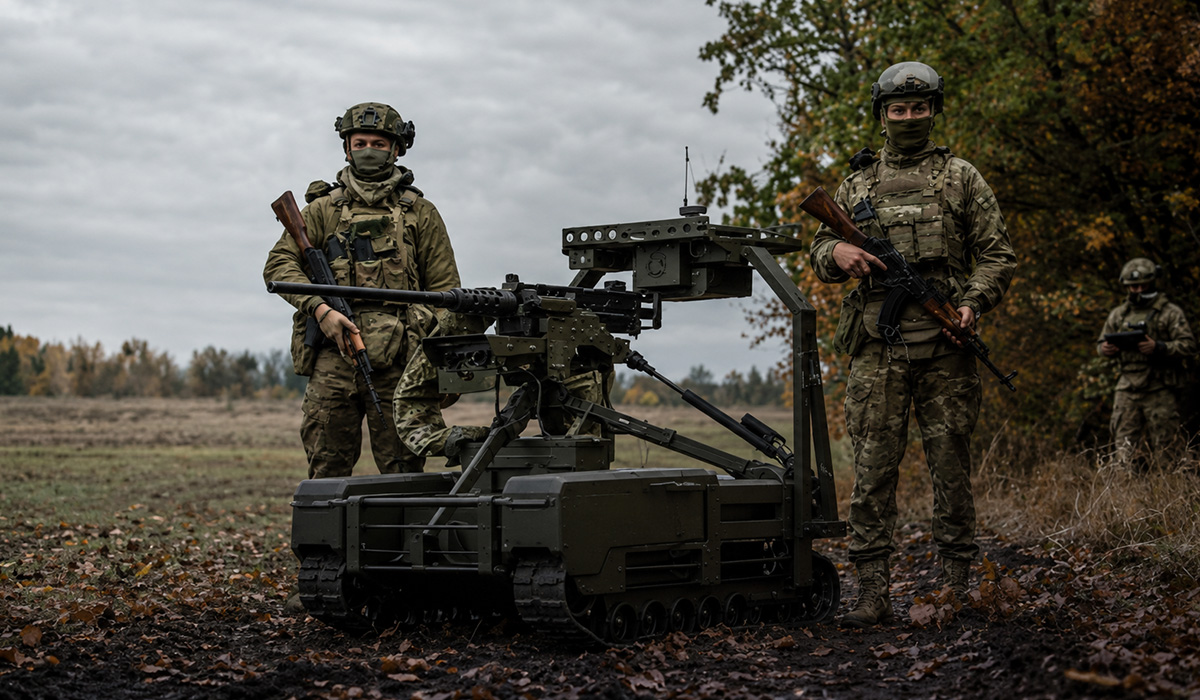
Modern warfare increasingly uses automated systems. Alongside drones in the air, unmanned ground platforms appear on the battlefield, which can perform dangerous or difficult tasks without the direct participation of a person. Such systems are applied for reconnaissance, transporting equipment, demining, and carrying out engineering tasks.
Ground robots make it possible to reduce risks to military units and increase the effectiveness of carrying out operations. Robotic platforms can work in difficult conditions, on minefields, in zones under fire, or in places where the presence of a person is dangerous.
According to the co-founder of BlueBird Tech Valeriy Zarubin, Ukraine has become one of the main centers of the creation of the newest military technologies. However, all of them so far cannot work completely autonomously.
And although the so-called “kill zone” on the front is gradually expanding, this does not mean that operators can work far from the line of contact.
“A large quantity of the newest assets was born in this war. But almost all such systems must be controlled by a human. If you look at the theater of combat operations, then on the line of contact, in trenches and dugouts, sit operators who control drones, logistics, strikes, and communication. Even if the kill zone is 100 kilometers, operators will all the same have to be relatively close to the LCC”, — notes the co-founder of BlueBird Tech Valeriy Zarubin.
Main Types of Ground Robots in Modern Warfare
Ground robots are gradually becoming an important element of modern military systems. In most cases, such machines are created in the form of compact robotic platforms on wheels or tracks, which can move over difficult terrain and work in dangerous zones.
In modern warfare, different types of military robots are used. These include reconnaissance robots for surveillance, engineering robots for carrying out special tasks, robotic platforms for transporting equipment, and unmanned ground systems for supporting units.
Such platforms can be equipped with surveillance cameras, thermal imagers, motion sensors, or special manipulators. Thanks to this, the operator gains the ability to monitor the situation from a distance and carry out tasks without direct contact with a dangerous environment.
The Principle of Remote Control of Robotic Platforms
Remote control is a constant exchange of data between the operator and the platform. Commands to move, stop, or perform tasks are transmitted forward, and video and telemetry are returned back. The whole system works as a closed loop, where each action depends on the speed of the response.
If the signal passes with a delay, control becomes less precise. Already at 1-2 seconds of delay the operator begins to react with a lag, and at a larger value an effect of ‘inertial control’ arises, when the platform moves faster than the operator can correct it.
In open terrain this effect is less noticeable, but in urban conditions or among obstacles it becomes critical. That is why remote control is always built taking delays into account rather than ideal conditions.
Video Transmission and Telemetry During Remote Control
For effective control, the operator needs not only a command but an understanding of the situation. Video shows the environment, and telemetry gives precise parameters of the platform’s operation — speed, position, signal level, and the state of the systems.
These two data streams work simultaneously but at different speeds. Telemetry is usually transmitted faster so that control remains stable even with video delays. It is what allows the operator to make decisions even if the picture lags slightly.
In practice the operator often relies more on telemetry than on video in difficult conditions. If the channel is overloaded, the system can reduce video quality but keep the control signals stable.
Robotic Platforms for Reconnaissance and Surveillance
One of the most widespread areas of using ground robots is reconnaissance. Compact robotic platforms can be used to observe terrain, check suspicious objects, or work in difficult urban conditions.
Such robots are usually equipped with video cameras, thermal imaging systems, and signal transmission assets. The operator can control the platform remotely and receive video in real time. This makes it possible to assess the situation without exposing military personnel to danger.
Such systems can be used to check buildings, tunnels, or other objects before units enter. Thanks to their compact size, they are able to work in places where the movement of a person is limited or dangerous.
Ground Robots for Logistics and Transportation
Another area of using military robotics is logistics. Robotic platforms can be applied for transporting ammunition, delivering equipment, or evacuating the wounded.
In the difficult conditions of combat operations, the movement of resources between positions is often associated with increased risk. The use of robotic systems makes it possible to perform such tasks remotely, which increases the safety of personnel and simplifies the supply of units.
Depending on the design of the platform, such robots can transport cargo from several dozen to several hundred kilograms and overcome difficult terrain. This makes them a useful tool for supporting units in the combat zone.
Robots for Demining and Engineering Tasks
One of the most important areas of using ground robots is engineering tasks, in particular the demining of territories. Robotic platforms can be used to detect and neutralize explosive objects.
Such systems are equipped with manipulators, surveillance cameras, and tools that allow the operator to work with suspicious objects at a safe distance. This significantly reduces the risk to military engineers when working in mined territories.
That is precisely why ground robots are actively used by engineering support units. More about the work of such specialists, their tasks, and equipment can be read in the article «A military engineer: who they are, what tasks they perform, and what tools they use in 2026», which explains the role of engineering units in modern combat operations.
Control Systems for Military Robotics
Ground robots are controlled remotely using special control panels and data transmission systems. Usually the operator is located at a safe distance and monitors the operation of the platform through a video signal and telemetry.
To transmit the signal, radio communication channels and secure digital control systems are used. The stability of such communication is critically important, since it is precisely what determines the ability to control a robotic platform in difficult terrain conditions or during combat operations.
In real operating conditions, the control system can be affected by interference or electronic warfare assets. That is precisely why, in modern operations, assets for countering unmanned systems are often applied. An example of such equipment is the «Hrets XL» EW system, which is used to counter enemy drones and helps protect positions from reconnaissance or strike drones.
Limitations on the Use of Ground Robots in Combat Conditions
Despite significant advantages, ground robots also have certain limitations. One of the main factors is the range of stable communication between the operator and the robotic platform.
In difficult terrain, in urban development, or in conditions of active electronic warfare, signal transmission can be complicated. This affects the effectiveness of robotic systems and requires the use of additional technical solutions.
Another limitation is the autonomy of operation. Most ground robots work on batteries or hybrid power systems, so their operating time is limited. In addition, difficult weather conditions, obstacles in the terrain, or damage to control systems can affect the capabilities of robotic platforms while carrying out tasks.
Conclusions
Ground robots are gradually becoming an important element of modern military equipment. Robotic platforms can perform reconnaissance, logistics, and engineering tasks, reducing risks to military units and increasing the effectiveness of operations.
The use of such systems makes it possible to work in dangerous conditions, carry out difficult tasks, and obtain additional information about the situation on the battlefield.