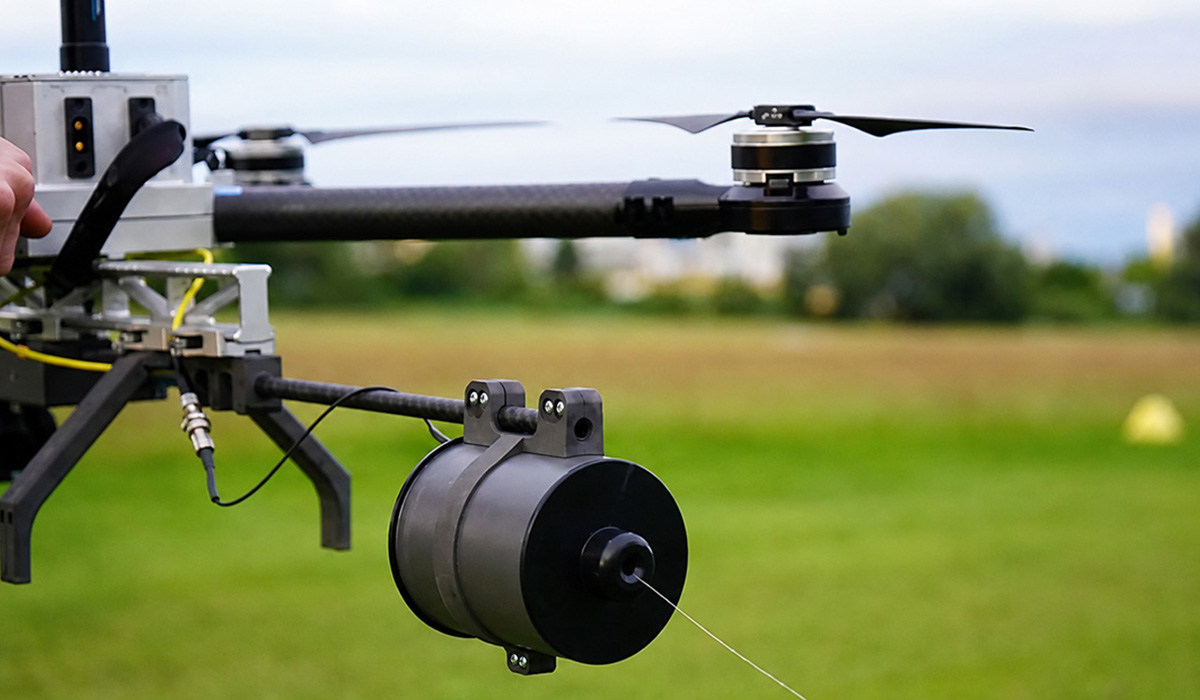
In modern electronic warfare conditions, classic FPV drones often go “blind” due to signal jamming. In response, a technology has emerged that significantly reduces vulnerability — the fiber-optic drone. We will explain what this solution is and why it could become a true breakthrough on the battlefield.
How does fiber-optic control work?
The system is as simple as it is technologically reliable. Instead of a wireless radio signal, a fiber-optic cable is used to connect the drone to the control unit. This provides the following advantages:
Stable connection. The cable is wound onto a spool that the drone carries with it during flight, ensuring a constant connection (without interruptions).
Complete protection against EW. Since the signal is not transmitted over a radio channel, it cannot be jammed or intercepted.
Stable video quality. The stream is transmitted without delays or losses. This is especially important for reconnaissance and fire adjustment.
In what situations are fiber-optic drones indispensable?
Under standard conditions, traditional FPV systems may suffice. But there are situations where communication must be flawless, regardless of interference. That is precisely when fiber-optic control becomes an indispensable tool, used wherever maximum reliability is required. Among the most complex and high-risk conditions:
Dense urban development. Concrete structures and metal constructions create obstacles for radio waves — but not for a cable.
Areas with active EW operations. Jammers have no effect on a cable connection, so the drone remains fully controllable.
Short-range operations near a target. Thanks to the reliable connection, it is possible to approach the target as closely as needed.
These conditions are a daily reality for Ukrainian units. That is why our company carefully studies the needs of frontline fighters and incorporates them into our developments. We are also working on fiber-optic control to ensure stable communication and precise control even in the most demanding conditions.
Overall, fiber-optic control is not merely a technical novelty, but a response to the real challenges of modern warfare and a solution for those who work daily under radio interference conditions and require uninterrupted communication in the most complex situations.
New trends at the front
In spring 2025, Ukraine first tested fiber-optic FPV drones with a range of over 20 km, and by April 2026, Ukrainian developers announced a fiber-optic drone with a record range of over 41 kilometers. Work on expanding the technical specifications of these vehicles is ongoing.
Additional options are also being added to FPV drones: from the ability to “see” in the dark to AI-assisted target guidance. For example, the Brave1 Market platform features serial models of fiber-optic drones of Ukrainian manufacture — including the «OSQ-13 Scorpion» with a range of up to 25 km and the «GHOST» with a range of 15 km, both equipped with thermal imaging cameras.
Russia has also ramped up serial production of cable-guided FPV drones: the device «Knyaz Vandal Novgorodsky» (developed by the Novgorod center «Ushkuynik»), and later its modification «Knyaz Veshchy Oleg», are being actively employed by the adversary. In April 2026, the Defence Intelligence of Ukraine published a component analysis of «Knyaz Veshchy Oleg», which showed that the product continues to depend on Western and Asian electronic components, despite sanctions.
Since a fiber-optic channel is physically immune to electronic warfare, conventional radio-electronic suppression methods do not work against it. At present, countermeasures consist primarily of engineering solutions (mainly netting and route concealment), mobile fire teams, and new technological approaches that are still being tested.
Aviation expert and development director of a defense enterprise Anatoliy Khrapchynskyi explained the essence of this technological leap: previously, a radio channel did not allow a drone to descend below the radio horizon, which limited its capabilities, whereas fiber optics removes this limitation entirely — the connection remains stable and completely invisible to any sensors. According to the expert, onboard detection systems simply “absolutely cannot see it.”
The expert divides the threat into different types, each requiring a separate countermeasure approach:
- The ground-based «lurker» — positioned along logistics routes and waits on a tether for a convoy or a single vehicle to pass. The most effective response is kinetic engagement.
- The mothership drone — loiters in the air and, at the right moment, releases a strike FPV already operating on a radio channel. Countermeasures here are more complex and require a combination of detection assets.
According to Khrapchynskyi’s forecast, the next step in the development of «lurkers» will be camouflaging their bodies to resemble natural objects (rocks, tree stumps, animals), which will complicate visual detection by reconnaissance patrols. The only reliable defense, in the expert’s view, is classical radar combined with kinetic strike assets. This is costly and complex, but currently there is no alternative.
It is entirely possible that by next year, fundamentally new solutions will appear at the front that will render current fiber-optic systems obsolete. Therefore, the technological advantage in this area will most likely be maintained only temporarily.