When choosing electronic warfare assets, the stated range of action often attracts attention first. It is precisely this indicator that is perceived as the main criterion of effectiveness, although in real combat conditions it almost never works the way it is indicated in the characteristics.
The action radius of EW is formed under the influence of many factors that are difficult to reduce to a single number. Power, frequencies, the type of antennas, terrain, and weather conditions can both substantially amplify and sharply reduce the effectiveness of a system.
What the Range of EW Is
The range of EW is a conditional indicator that describes the zone within which the system is able to affect the enemy’s radio channels. In documentation, it is usually indicated for ideal conditions, without taking into account obstacles and changes in the environment.
In reality, the action radius is formed dynamically. It changes depending on the direction of radiation, the height of installation, the presence of obstacles, and the activity of other signal sources. Therefore, the same system can work differently even on neighboring sections.
An understanding of this makes it possible to avoid the false perception of range as a guaranteed parameter and to approach the planning of EW application correctly.
Power and the Frequency Range
Radiation power directly affects the ability of EW to override communication channels, but it is not the only determining factor. Even high power does not guarantee effectiveness if the system works outside the enemy’s current frequencies.
The frequency range is of key significance, since drones and other communication assets can quickly change operating frequencies. If EW does not cover these bands, the real action radius is sharply shortened.
That is precisely why, when assessing effectiveness, it is important to take into account not only the stated power but also the correspondence of frequencies to specific threats. More about this can be learned in the article: «EW frequencies — which to choose?», which examines practical approaches to choosing operating bands.
The Role of Antennas and Terrain
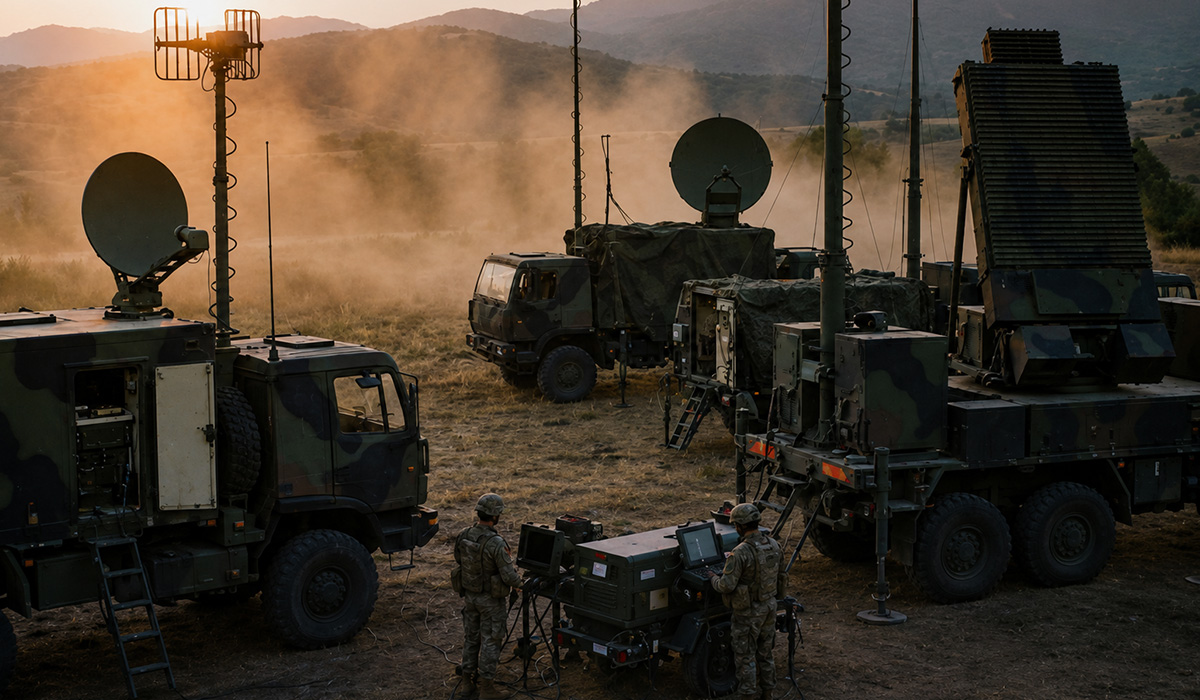
Antennas determine the shape and direction of the EW impact zone. Their type, orientation, and height of installation directly affect the real action radius. An incorrectly placed antenna can negate the potential of even a powerful system.
The terrain also plays a decisive role. Hills, forest areas, development, and other obstacles screen the signal and create so-called «shadows» where the impact of EW weakens or disappears.
Therefore, the assessment of the range of action must always take into account the specific conditions of the terrain, and not only the technical characteristics of the equipment.
The Impact of Weather Conditions
Weather conditions do not change the operating principle of EW but can affect the stability of the signal and the propagation of radio waves. Precipitation, high humidity, or strong wind are able to change the characteristics of the environment, especially at boundary distances.
In difficult weather conditions, the zone of effective impact can decrease or become unstable. This is especially noticeable when working at long distances, where the signal is already at the limit of the system’s capabilities.
Taking the weather factor into account makes it possible to avoid false expectations and adjust the tactics of EW application in real time.
Typical Mistakes in Assessing Effectiveness
One of the most common mistakes is the perception of the nominal action radius as guaranteed coverage. In combat conditions, such an assessment leads to gaps in protection and the incorrect placement of the system.
Another mistake is ignoring changes in the enemy’s frequencies and tactics. EW configured for outdated parameters can demonstrate minimal effectiveness even with correct placement.
The mutual influence of one’s own communication systems, which creates interference and reduces the real action radius, is also often underestimated.
How to Correctly Plan Coverage
Planning EW coverage must begin with an analysis of threats and the conditions of the terrain. Instead of focusing on a single number, it is necessary to assess the directions of possible attacks, the terrain, and zones that require priority protection.
Effective coverage is often achieved not at the expense of maximum range but through correct placement and the combination of systems. In this context, dome solutions are used, in particular the dome EW “Hrets” 5UL, which is intended to protect positions within a defined radius.
Such an approach makes it possible to adapt EW to real combat conditions and obtain a predictable result.
Conclusions
The range of EW is a variable indicator that is formed under the influence of technical and external factors. Power, frequencies, antennas, terrain, and weather conditions are equally important for the real effectiveness of the system.
Assessing EW only by nominal characteristics does not give an objective idea of its capabilities. Only a comprehensive approach to planning and application makes it possible to use the system as effectively as possible in combat conditions.