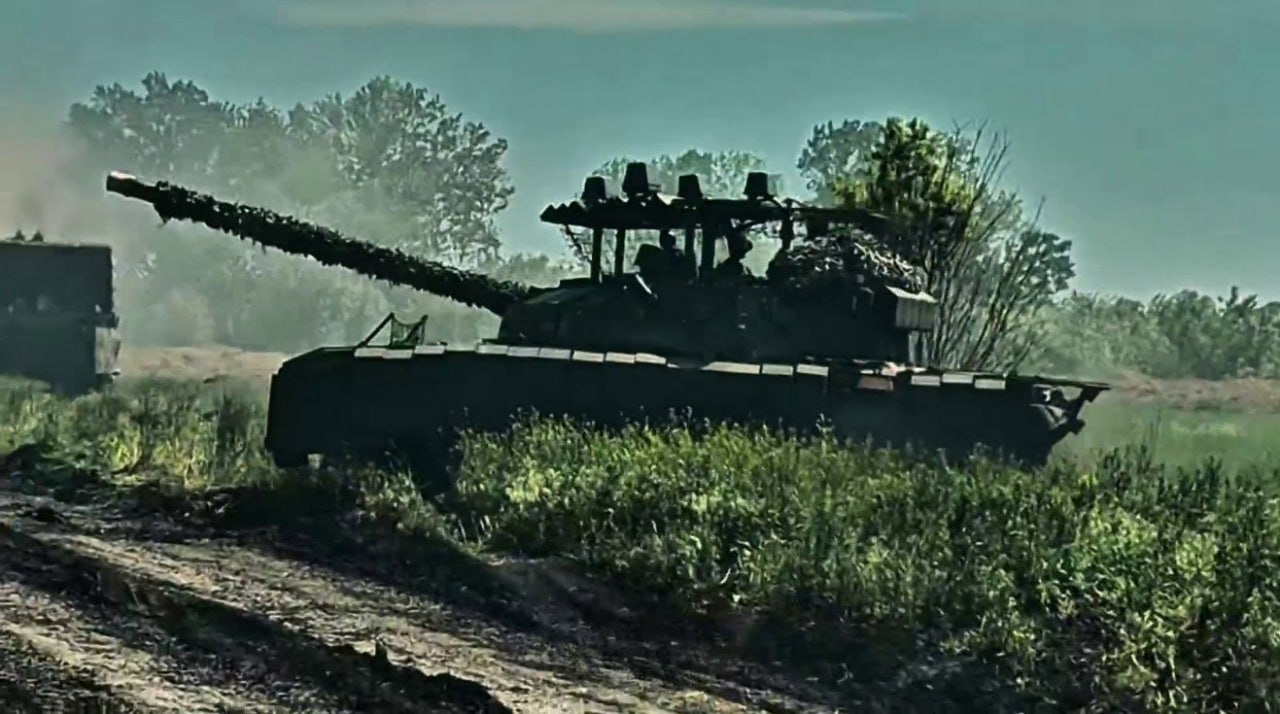
A T-72B3A tank equipped with the upgraded Arena-M active protection system, which was supposed to shield the vehicle from FPV drones, failed to engage the attacking drone near Mayak in the Donetsk region. Footage of the strike on July 23 was released by the Special Operations Center «Omega» of the National Guard of Ukraine.
According to SOC «Omega», the FPV drone attack targeted a column of ten Russian tanks. The video captures a hit on the rear projection of the T-72B3A — the most vulnerable armored zone, where the engine and transmission are typically located. The exact number of vehicles in the column equipped with Arena-M has not yet been determined.
As early as November 2025, Russian engineers encountered a problem: the radar struggled to detect mini- and micro-drones with bodies made of radio-transparent materials such as plastic. Experts pointed to the radar’s inability to distinguish small aerial objects from background reflections of the ground surface at short distances.
Here is the publicly known combat history of the upgraded system:
- 2019 — integration of Arena-M onto the T-72B3 and T-90M begins.
- 2024 — a contract for serial production of tanks with APS is announced.
- Spring 2025 — the first photos appear of a T-72B3A with Arena-M, reportedly taken at the front.
- July 7, 2026 — Russian media document a T-72B3A with Arena-M as part of the «Center» grouping on the Dnipropetrovsk axis — the tank was firing from a concealed position.
- July 23, 2026, morning — reports emerge of another T-72B3A with Arena-M being fitted with an additional anti-mine trawl.
- July 23, 2026, evening — SOC «Omega» releases footage of such a tank being struck by an FPV drone near Mayak in the Donetsk region.
In other words, within a single day Russian sources presented yet another technical upgrade to the vehicle, while Ukrainian forces released video of its destruction in combat.
The system, developed by the Mechanical Engineering Design Bureau (KBM, Kolomna), is based on an architecture that Russia has been developing since the late 1980s. Key parameters of the baseline version:
- Radar — a multifunctional 360-degree surveillance radar with six transceiver antennas around the turret perimeter.
- Detection range — approximately 50 meters from the tank.
- Reaction time — target interception within 50–70 milliseconds of detection; the defensive munition detonates at a distance of 1.5–2 meters from the armor.
- Target speed range — the original Arena version is designed for objects traveling at 70–700 m/s; the upgraded Arena-M, according to the developers, is capable of intercepting munitions at speeds of up to 1,200 m/s.
- Ammunition load — 22–26 narrow-beam defensive munitions in launch cells around the turret, with the ability to be replenished in field conditions.
- System weight — approximately 1 tonne.
The baseline Arena was never designed for drones: it was built to counter ATGMs, RPGs, and artillery shells arriving from predictable directions at relatively high speeds. The upgrade announced in Russia for 2025 was intended to expand the traverse angle of the radar receiving module to counter targets diving at angles of 50–85 degrees.